Area and Perimeter: Choose the Quantity Before the Formula
Perimeter measures a boundary. Area measures a surface. A labeled sketch, compatible units and a sensible estimate prevent many errors before any formula is used.
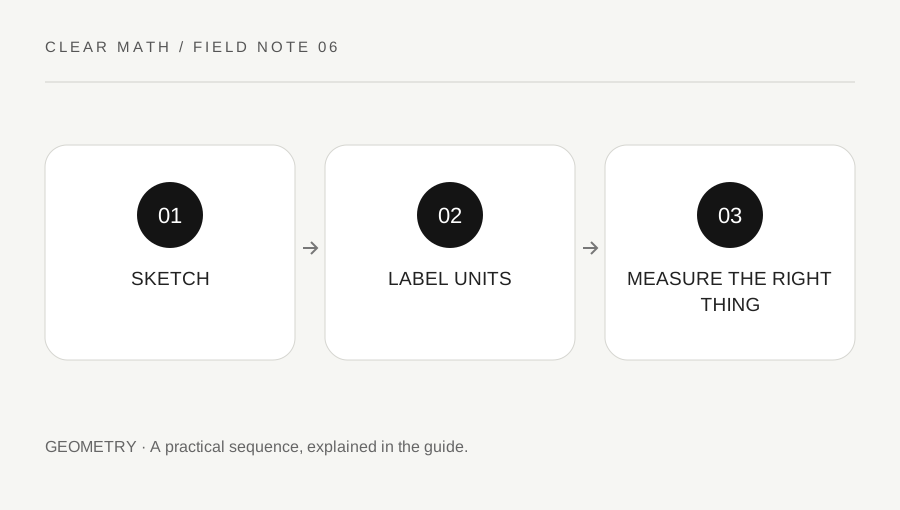
Original explanatory diagram. Numerical examples in this guide illustrate the reasoning; they are not a claim of hands-on testing.
Decide what the question measures
Imagine a rectangle drawn on square paper. Tracing its outside edge measures perimeter, a length. Counting the unit squares inside measures area, a two-dimensional quantity. A rectangle six centimeters long and four centimeters wide has perimeter 6 + 4 + 6 + 4 = 20 centimeters and area 6 × 4 = 24 square centimeters.
The numbers twenty and twenty-four do not compete to be the “right size” of the rectangle. They answer different questions and carry different units. Before choosing a formula, write a sentence such as “I need the distance around the outside” or “I need the amount of surface inside.” A clear sentence is often more useful than a page of memorized formulas.
Use compatible measurements
For a rectangle measuring two meters by fifty centimeters, first express both sides in matching units. Two meters equals two hundred centimeters, so the area is 200 × 50 = 10,000 square centimeters. Equivalently, fifty centimeters equals 0.5 meters, and the area is 2 × 0.5 = 1 square meter.
One square meter contains 10,000 square centimeters because it is a square one hundred centimeters along each side. Do not convert area by multiplying or dividing by one hundred, the factor used for length alone. Draw a one-meter square split into a hundred-by-hundred grid if this conversion seems surprising. For volumes, three dimensions are involved and the conversion factor changes again.
Understand the triangle formula
A triangle's area is half its base multiplied by its perpendicular height. The height meets the base, or the line containing the base, at a right angle. A sloping side is not automatically the height. For a triangle with base eight centimeters and perpendicular height five centimeters, the area is 1/2 × 8 × 5 = 20 square centimeters.
One explanation is to pair two matching triangles into a parallelogram. The parallelogram has area base × height, and each triangle occupies half. In an obtuse triangle, the perpendicular height may fall outside the drawn triangle. Extend the base line in your sketch rather than substituting an easier-looking side length. Perimeter still requires the lengths of all three sides, not the height alone.
Break a composite shape into simpler regions
Consider an L-shaped region formed from an eight-by-six rectangle with a three-by-two corner removed, all in centimeters. The full rectangle has area forty-eight square centimeters. The removed corner has area six, leaving forty-two. Alternatively, split the L into two non-overlapping rectangles and add their areas, carefully identifying their actual dimensions.
Perimeter needs a separate boundary trace. Do not subtract the removed rectangle's entire perimeter from the original perimeter: some old outside edges disappear and new edges appear. Mark each boundary segment and add it once. A grid sketch helps reveal missing lengths. If the diagram is labeled “not to scale,” use its given measurements and logical relationships rather than estimating a length from the printed picture.
Check scale and reasonableness
If every side of a rectangle doubles, the perimeter doubles but the area becomes four times as large. A three-by-five rectangle has perimeter sixteen and area fifteen; a six-by-ten rectangle has perimeter thirty-two and area sixty. This is a useful check when working with enlarged diagrams and when converting square units.
Practice with a nine-by-four rectangle and a triangle with base twelve and height seven. The rectangle's perimeter is twenty-six length units and its area thirty-six square units. The triangle's area is forty-two square units. State what information would still be needed for the triangle's perimeter: its side lengths. Finish by checking that every final unit matches the quantity requested and that no unprovided measurement was silently assumed.
A practical checklist
Tick items for your own use. This checklist is saved only in this browser.
Questions that come up
Can shapes have the same area but different perimeters?
Yes. A three-by-four rectangle and a two-by-six rectangle both have area twelve, while their perimeters are fourteen and sixteen.
Can I calculate triangle perimeter from base and height alone?
Not in general. Those values determine area, but additional side information or a special stated triangle type is needed for perimeter.
Why does my area have square units?
Area counts unit squares across two dimensions. Multiplying a length by a length produces square units, such as centimeters squared.
References & scope
Background references checked on 18 October 2026. The examples and practice exercises are original editorial explanations, not copied procedures or professional advice.