Percentages: Find the Part, the Rate or the Whole
A percentage describes a part relative to a stated whole. Identify what is known and what is missing before choosing a calculation. The same relationship solves three common kinds of question.
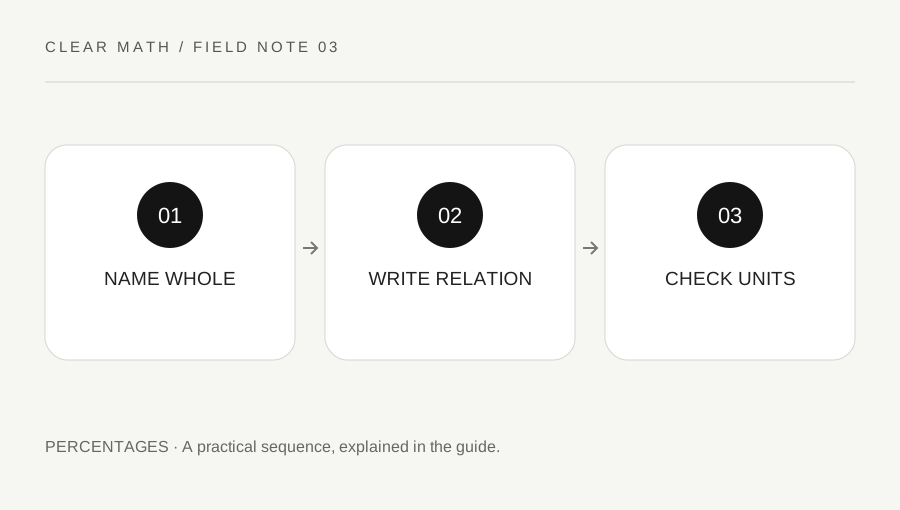
Original explanatory diagram. Numerical examples in this guide illustrate the reasoning; they are not a claim of hands-on testing.
Treat percent as a rate per hundred
Twenty-five percent means twenty-five per hundred, or 25/100 = 0.25. A statement such as “25% of the counters are blue” is incomplete for a count until you know the total number of counters. In a collection of forty counters, one quarter are ten. In a collection of eighty, the same percentage represents twenty.
Write the whole beside the number rather than relying on memory. When a problem refers to different groups, percentages may use different denominators. Half of one class and half of another class need not be the same number of learners. This guide uses counts, distances and classroom examples; its purpose is mathematical reasoning rather than recommendations about personal finance.
Find a part when the whole is known
Suppose 35% of sixty seedlings have been labeled. Convert 35% to 0.35 and multiply: 0.35 × 60 = 21 seedlings. A second route is 30% plus 5%: eighteen plus three also gives twenty-one. Use whichever route helps you see the relationship, and retain the unit with the answer.
For 12.5% of eighty objects, recognize 12.5% as one eighth. One eighth of eighty is ten. Do not assume every percentage question requires a complicated decimal calculation. Estimation helps: 35% is between one third and two fifths, so the result for sixty should be between twenty and twenty-four. Twenty-one fits; two hundred ten does not.
Find a percentage when part and whole are known
If eighteen of twenty-four practice questions are correct, calculate 18 ÷ 24 = 0.75, then multiply by 100 to express the result as 75%. Simplifying the fraction to 3/4 gives the same answer. Label eighteen as the part and twenty-four as the whole before dividing; reversing them produces a number greater than one that does not describe the requested fraction correct.
Sometimes the part can exceed the comparison base, as when comparing a new quantity with an earlier quantity. A value above 100% is then possible. But for questions about a subset of a fixed collection, the part cannot exceed the whole. Use the context to decide whether an answer above 100% is meaningful or a signal that the inputs have been mixed up.
Find the missing whole
A group of twelve red counters is 30% of a larger collection. Write 12 = 0.30 × whole. Divide twelve by 0.30 to obtain forty counters. Check by taking 30% of forty: the result is twelve. Multiplying twelve by 0.30 would instead find 30% of twelve, a different question.
A bar model can make this visible. If three equal tenths contain twelve counters, each tenth contains four, so ten tenths contain forty. This representation is especially helpful when an equation feels unfamiliar. For a zero percent rate, a nonzero part is inconsistent, while a zero part does not uniquely determine the whole. Avoid blindly dividing by zero when a word problem has unusual or incomplete information.
Separate percentage points from relative change
A quiz score moves from 60% to 75%. The difference is fifteen percentage points. Relative to the earlier score, the increase is 15 ÷ 60 = 0.25, or 25%. Both statements can be correct because they answer different questions. Always state the starting value when calculating a relative change.
Practice these three forms: find 15% of 120, express twenty-one out of twenty-eight as a percentage, and find the whole when fourteen is 35%. The answers are eighteen, 75% and forty. Finish by writing the relationship “part = rate × whole” with the rate as a decimal. This one sentence helps you select multiplication or division instead of guessing from a keyword such as “of.”
A practical checklist
Tick items for your own use. This checklist is saved only in this browser.
Questions that come up
Why divide by 100?
Percent means per hundred. Dividing the stated percentage by 100 converts it into the multiplier used with the whole.
Is 0.5% the same as 50%?
No. 0.5% is 0.005 as a multiplier, while 50% is 0.5. Writing the conversion explicitly prevents a hundredfold error.
Should every answer be rounded to a whole number?
No. Use the requested accuracy and context. Keep intermediate values exact where possible, then round the final result appropriately.
References & scope
Background references checked on 18 October 2026. The examples and practice exercises are original editorial explanations, not copied procedures or professional advice.