Order of Operations: Read the Structure Before Calculating
Operation order makes a written expression unambiguous. Work inside grouping symbols first, handle powers, then perform multiplication and division together before addition and subtraction together.
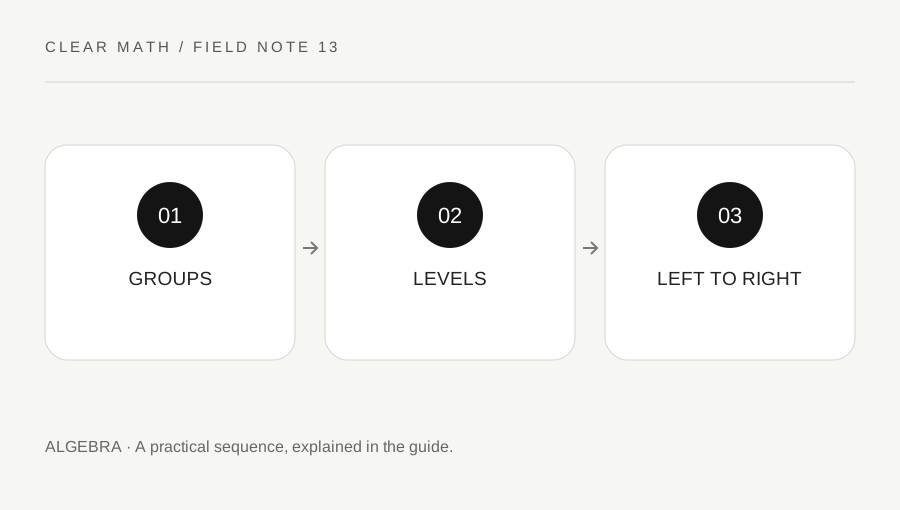
Original explanatory diagram. Numerical examples in this guide illustrate the reasoning; they are not a claim of hands-on testing.
Use grouping to reveal the intended expression
Compare 3 + 4 × 2 with (3 + 4) × 2. The first equals eleven because multiplication is performed before addition. The second equals fourteen because the parentheses require the sum seven to be found before multiplying by two. The numbers are identical, but the structure changes.
Read the expression as a whole before beginning. A fraction bar also groups its numerator and denominator, so (6 + 2)/4 equals two. Without the grouping, 6 + 2/4 equals six and one half. When typing into a calculator, use parentheses to reproduce the intended numerator, denominator or grouped quantity.
Avoid treating a written line as a sequence of commands to execute strictly from the first symbol. Mathematical notation contains a hierarchy. Marking the largest grouped pieces first helps you preserve that hierarchy while simplifying.
Treat equal-priority operations as one level
Multiplication and division have equal priority and are evaluated from left to right in an ungrouped sequence. For 24 ÷ 6 × 2, calculate 24 ÷ 6 = 4, then 4 × 2 = 8. Doing the multiplication 6 × 2 first would answer 24 ÷ (6 × 2), a differently grouped expression.
Addition and subtraction also share one level. For 10 − 3 + 2, work left to right to get seven plus two, or nine. Adding three and two first would produce five and change the meaning. Mnemonics can be misleading if their letters suggest that every multiplication must happen before every division, or every addition before every subtraction.
Write one replacement per line while learning. Keep untouched parts of the expression visible so that a local calculation does not accidentally erase or regroup a later term.
Handle powers and negative signs deliberately
For 2 + 3² × 4, calculate the power first: 3² = 9. Then multiply nine by four to get thirty-six, and add two to obtain thirty-eight. The exponent applies to the base immediately indicated, not to an entire nearby sum unless parentheses show that grouping.
Compare (−3)² with −3². In the first, the base is negative three, so the product is nine. Under standard algebraic convention, the second means the negative of 3² and equals negative nine. If a calculator's input style is unclear, use explicit parentheses instead of hoping the device interprets the expression as intended.
For nested grouping, start at the innermost group. In 2[5 − (3 − 1)], the inner difference is two, the bracket becomes three and the final product is six. Square brackets serve as grouping symbols here.
Check with an alternative representation
Evaluate 18 ÷ 3 + 2 × (5 − 1). The group gives four, division gives six and multiplication gives eight, so the result is fourteen. Rewrite the expression as 18/3 + 2×4 to make the two additive terms visible. This second view helps verify that neither operation was misplaced.
Practice 7 − 2×3, (7−2)×3, and 20÷5×2. The answers are one, fifteen and eight. Explain which pair changes grouping and which example tests equal-priority left-to-right order. A correct answer with an unclear explanation is a reason to slow down, not to increase the expression length immediately.
When an expression copied from a message or image is genuinely ambiguous, clarify the grouping before calculating. Adding parentheses in your own work is a useful communication habit. A numerical answer is only meaningful once the mathematical expression being evaluated is clear.
A useful correction exercise is to insert parentheses into 8 − 2 × 3 to obtain eighteen: (8 − 2) × 3. Compare this with the original value two. Explain that the parentheses changed the expression rather than correcting its arithmetic.
A practical checklist
Tick items for your own use. This checklist is saved only in this browser.
Questions that come up
Does multiplication always come before division?
No. They have equal priority in standard operation order. Evaluate an ungrouped sequence of those operations from left to right.
Are brackets different from parentheses?
In these elementary expressions both indicate grouping. Other mathematical contexts can assign special meanings, so read the surrounding notation.
Why did two calculators give different answers?
Input interpretation or grouping may differ. Re-enter the intended expression using explicit parentheses and inspect the intermediate structure before comparing results.
References & scope
Background references checked on 18 October 2026. The examples and practice exercises are original editorial explanations, not copied procedures or professional advice.