Multiply and Divide Fractions: Models, Signs and Zero
Multiplication can mean taking part of a quantity. Division can ask how many groups fit. Connect those meanings to the written rules before practicing with positive and negative fractions.
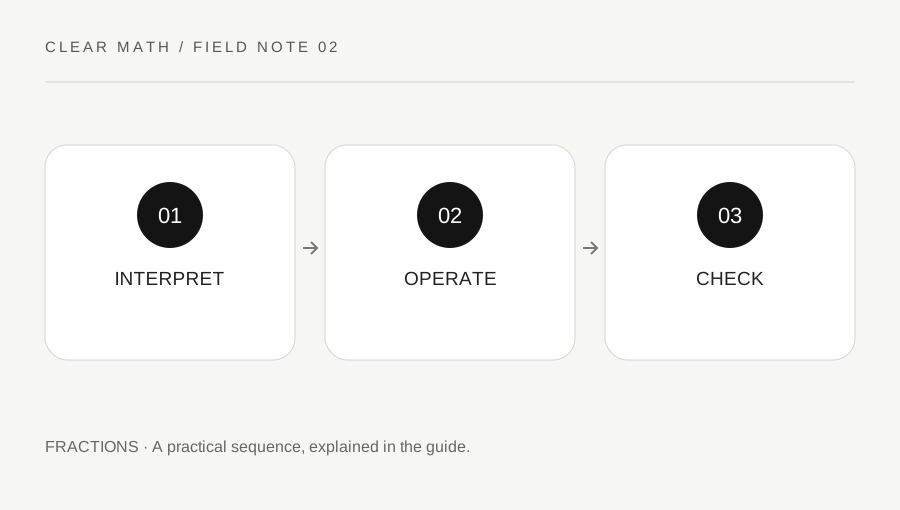
Original explanatory diagram. Numerical examples in this guide illustrate the reasoning; they are not a claim of hands-on testing.
Picture a fraction of a fraction
Take a rectangular sheet and shade three fifths of its area with vertical bands. Now mark half of that shaded region using a horizontal line. The overlapping area covers three of the ten equal small rectangles. This models 1/2 × 3/5 = 3/10. The numerator counts selected small pieces and the denominator counts all equal pieces in the whole.
Multiplying two positive fractions smaller than one makes a result smaller than either factor. That observation is a useful check, not a rule for every multiplication. Multiplying by two increases a positive value, while multiplying by one leaves it unchanged. State which case you are in before assuming that multiplication must always make something larger.
Multiply, then simplify
The written rule is (a/b) × (c/d) = (a×c)/(b×d), with nonzero denominators. For 4/9 × 3/8, the direct product is 12/72, which reduces to 1/6. You may cancel a common factor between a numerator and a denominator before multiplying: divide four and eight by four, and three and nine by three, leaving 1/3 × 1/2.
Cancellation works on factors in a product. It does not let you cross out matching digits inside numbers, and it does not work across the plus sign in an expression such as (2+3)/3. Write a factorization line if you are unsure what is being divided. The calculator gives the unreduced product and the greatest common divisor so that this step remains visible.
Interpret division as a comparison of groups
How many portions of size 1/4 fit into 3/4? Three do, so 3/4 ÷ 1/4 = 3. How many portions of size 2/3 fit into 5/6? Compare both using sixths: a portion is 4/6, and the available quantity is 5/6. That gives 5/4 of a portion, or 1 1/4.
The general rule multiplies by the divisor's reciprocal: (a/b) ÷ (c/d) = (a/b) × (d/c). Only the second fraction is inverted. For the example, 5/6 × 3/2 = 15/12 = 5/4. Check by multiplying your answer by the original divisor. The product should return the original dividend.
Keep signs and zero under control
One negative factor and one positive factor produce a negative product; two negative factors produce a positive product. Division follows the same sign pattern. Thus −2/3 ÷ 4/5 becomes −2/3 × 5/4 = −10/12 = −5/6. A negative denominator can be moved to the numerator without changing the value: 2/−3 = −2/3.
A denominator of zero is never allowed. Zero divided by a nonzero number is zero, so 0/7 ÷ 2/3 = 0. Dividing by a zero-valued fraction is undefined, so 2/3 ÷ 0/5 must be rejected. Flipping 0/5 would create 5/0 and does not solve the problem. Check this before applying the reciprocal rule mechanically.
Practice with a predicted size
Try 3/7 × 14/15, 4/5 ÷ 2/3 and −5/8 × −4/9. Predict the sign and whether the result should be larger or smaller than the first positive magnitude. The simplified answers are 2/5, 6/5 and 5/18. For the division question, multiplying 6/5 by 2/3 returns 12/15, or 4/5.
Write one sentence explaining each check. For example, dividing 4/5 into groups of size 2/3 gives more than one group because 4/5 is larger than 2/3. If the calculator disagrees, inspect which fraction you inverted and whether you retained the sign. Use the next practice question only after you can explain that correction in words.
A practical checklist
Tick items for your own use. This checklist is saved only in this browser.
Questions that come up
Does division always make a number smaller?
No. Dividing a positive quantity by a positive fraction below one produces a larger numerical quotient because each group is smaller than one unit.
Can the numerator be zero?
Yes, if its denominator is nonzero. The fraction then equals zero. It cannot be used as the divisor in a division problem.
Do I have to cancel before multiplying?
No. Multiplying first and simplifying afterward is valid. Early cancellation often makes the arithmetic smaller.
References & scope
Background references checked on 18 October 2026. The examples and practice exercises are original editorial explanations, not copied procedures or professional advice.