Add and Subtract Fractions Without Losing the Meaning
A denominator names the size of a piece. Before combining fractions, make those pieces comparable. A short drawing and a careful equivalent-fraction step make the arithmetic easier to check.
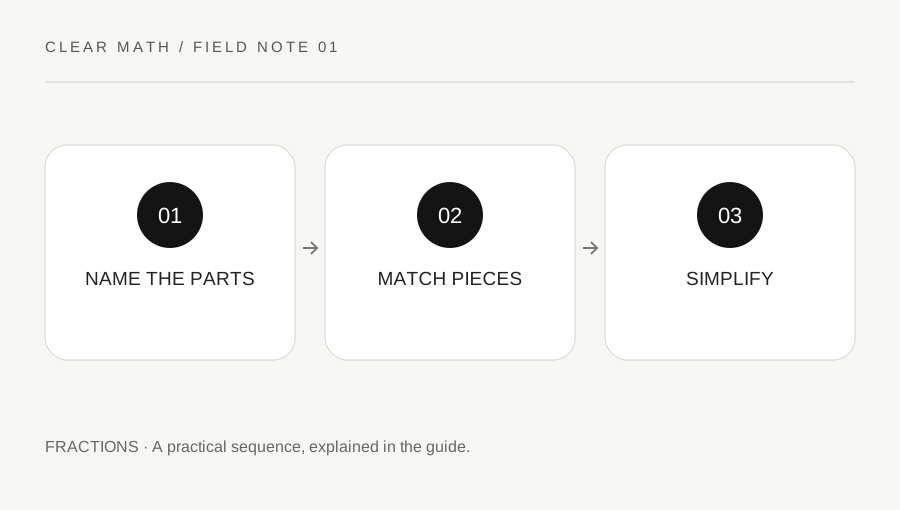
Original explanatory diagram. Numerical examples in this guide illustrate the reasoning; they are not a claim of hands-on testing.
Begin with the same whole
Imagine two identical paper strips. Divide one into four equal sections and shade one. Divide the other into six equal sections and shade one. Both shaded areas are parts of the same-sized whole, but a quarter is larger than a sixth. Adding their numerators and denominators would produce two tenths, which does not describe the combined shaded length.
The whole matters as much as the labels. Half of a long strip and half of a short strip are not equal lengths. In a school fraction problem, the fractions normally refer to the same unit whole. State that assumption when using a drawing. Mark every section equally; an attractive sketch with uneven sections can suggest an incorrect relationship.
Rewrite using a common denominator
For 1/4 + 1/6, twelve is a convenient common denominator because both four and six divide it exactly. Multiply the numerator and denominator of 1/4 by three to obtain 3/12. Multiply both parts of 1/6 by two to obtain 2/12. These changes rename each quantity without changing its value: multiplying by 3/3 or 2/2 is multiplying by one.
Now combine three twelfths and two twelfths to obtain 5/12. The denominator stays twelve because you are counting twelfth-sized pieces. You can also use twenty-fourths, obtaining 6/24 + 4/24 = 10/24, and simplify afterward. The smallest common denominator often makes the work shorter, but it is not the only correct common denominator.
Subtract with the same structure
Try 5/6 − 1/4. Convert to twelfths: 10/12 − 3/12 = 7/12. Draw ten twelfth-sized sections and cross out three if the subtraction feels abstract. Estimate first: five sixths is a little below one, and a quarter is about one fourth, so a result slightly above one half is reasonable. Seven twelfths passes that check.
Negative answers follow the same rule. For 1/4 − 5/6, use 3/12 − 10/12 = −7/12. A number line helps here: start at one quarter, then move five sixths to the left. Do not replace a negative answer with a positive answer merely because the drawing of physical pieces becomes less convenient.
Simplify and check equivalent answers
For 2/9 + 1/3, rewrite the second fraction as 3/9. The sum is 5/9, already in simplest form. For 1/6 + 1/3, the sum is 3/6, which simplifies to 1/2 by dividing both numerator and denominator by three. Reduction changes the written form, not the quantity.
Use the calculator after writing your own common-denominator line. Compare that intermediate line before comparing the final answer. If you got 4/10 for 1/4 + 1/6, the error is in combining unlike parts. If you got 10/24, your method can be correct even though the result needs reduction. Explaining the location of a mistake teaches more than erasing everything and copying a final fraction.
Use a short practice routine
Work three questions: 1/5 + 3/10, 7/8 − 1/6, and −1/3 + 5/12. Write an estimate, a common-denominator line and a simplified result for each. The answers are 1/2, 17/24 and 1/12. For the second question, 21/24 − 4/24 gives 17/24. For the third, −4/12 + 5/12 leaves one positive twelfth.
Review the denominator choices rather than timing the page. If all three are correct, change one numerator to make a negative answer or an improper fraction. If one is wrong, draw only that example and describe the unit parts aloud. A smaller set with a clear correction is more useful than a long worksheet completed by repeating an unexplained rule.
A practical checklist
Tick items for your own use. This checklist is saved only in this browser.
Questions that come up
Must I find the least common denominator?
No. Any nonzero common denominator works. A smaller one usually reduces arithmetic, and the final answer should still be simplified.
Can I add the denominators?
No. In ordinary fraction addition, denominators identify piece size. Rename the fractions so the sizes match, then count the pieces.
Why does the calculator show a different intermediate denominator?
It uses a common multiple based on the entered denominators. Your equivalent fraction is valid if its value and final simplified result match.
References & scope
Background references checked on 18 October 2026. The examples and practice exercises are original editorial explanations, not copied procedures or professional advice.