Solve a Simple Inequality and Show the Boundary
An inequality describes a range of possible values. Preserve the comparison while simplifying, and show whether the boundary itself belongs to the answer.
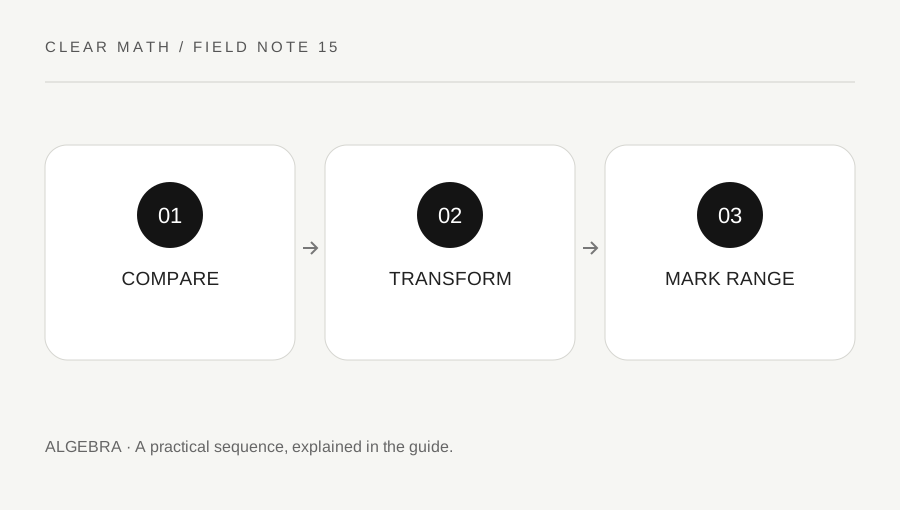
Original explanatory diagram. Numerical examples in this guide illustrate the reasoning; they are not a claim of hands-on testing.
Read the comparison precisely
The statement x > 3 allows values greater than three, while x ≥ 3 also includes three. On a number line, an open circle usually marks an excluded boundary and a filled circle an included boundary. Shade toward values satisfying the statement.
State the domain if restricted. Over real numbers, x > 3 includes 3.1 and 3.001 as well as integers. Over integers only, the first allowed value above three is four. A problem about counting whole objects can create that restriction, but do not silently add it to a purely algebraic inequality.
Read the symbol in words before solving. “At least,” “more than,” “at most” and “less than” differ in whether equality is allowed. The same boundary number can produce different solution sets, so a complete answer needs both the boundary and the comparison direction.
Add or subtract the same quantity
Solve x + 4 ≤ 9 by subtracting four from both sides, giving x ≤ 5. Adding or subtracting the same quantity preserves order because it shifts both values equally along the number line. Check the boundary: five plus four equals nine, so equality is allowed.
Test an interior value such as x = 2, giving 6 ≤ 9, which is true. Test an outside value such as x = 7, giving 11 ≤ 9, which is false. These checks verify both the boundary and the solution direction.
Avoid writing only x = 5. That names the boundary but loses the rest of the allowed values. An inequality solution is often a set, unlike the single value encountered in a basic equation. Draw the graph while explaining which side contains the successful test value.
Reverse order after multiplying by a negative
For 3x < 12, dividing by positive three preserves the comparison and gives x < 4. For −2x < 6, dividing by negative two reverses it, producing x > −3. The reversal is essential, not an optional notation choice.
Inspect a familiar pair: 2 < 5, but multiplying both by negative one gives −2 > −5. Reflection across zero reverses their positions. The same reasoning applies when dividing both sides by a known negative number.
Check −2x < 6 with x = 0: zero is less than six, so zero should be included, consistent with x > −3. The boundary x = −3 gives six less than six, which is false, so use an open circle. Do not divide by a variable of unknown sign without considering separate cases and a possible zero value.
Represent and verify a range
Solve 5 − 2x ≥ 11. Subtract five to obtain −2x ≥ 6. Divide by negative two and reverse the comparison: x ≤ −3. Mark a filled circle at negative three and shade left. Substitute the boundary and one value on each side to check.
Practice x−7 > −2, 4x ≤ 20 and −3x ≥ 12. The answers are x > 5, x ≤ 5 and x ≤ −4. Describe each graph aloud: open at five to the right; filled at five to the left; filled at negative four to the left.
Record which operation required a reversal. “Divided by a negative and forgot to reverse” identifies a correctable step. Memorizing a final arrow direction without its reason is less useful, especially when the same inequality is rewritten with the sides exchanged. Read the resulting statement again before deciding that two forms disagree.
Reversing the written sides also reverses the symbol: x ≤ −3 and −3 ≥ x describe the same set. Test x = −5 in both forms to see why their different visual directions do not indicate different mathematical answers.
A practical checklist
Tick items for your own use. This checklist is saved only in this browser.
Questions that come up
Does subtraction reverse an inequality?
No. Adding or subtracting the same quantity preserves order. Multiplying or dividing by a known negative value reverses it.
Why is the boundary sometimes open?
A strict less-than or greater-than comparison excludes equality. An open circle records that excluded boundary on a typical number-line graph.
Can I divide both sides by x?
Not without checking its sign and whether it could be zero. These beginner examples divide only by known nonzero constants.
References & scope
Background references checked on 18 October 2026. The examples and practice exercises are original editorial explanations, not copied procedures or professional advice.