Fractions and Decimals: Exact Values, Repeats and Approximations
A fraction and a decimal can name the same number. Some fractions end neatly in decimal form; others repeat. Keep an exact fraction when rounding would hide the relationship you need.
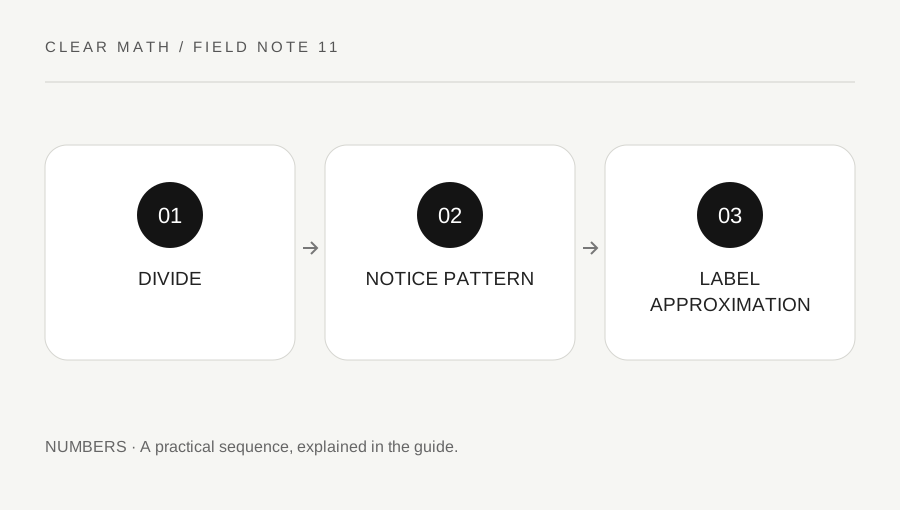
Original explanatory diagram. Numerical examples in this guide illustrate the reasoning; they are not a claim of hands-on testing.
Read a decimal as a fraction of a power of ten
The decimal 0.375 means 375 thousandths, so it equals 375/1000. Divide numerator and denominator by 125 to reduce it to 3/8. The place of the final digit determines the initial denominator. For 0.04, use 4/100 = 1/25, not 4/10.
A decimal with a whole-number part can be handled the same way. The value 2.45 equals 245/100, which simplifies to 49/20. You may also write 2 + 45/100 and reduce the fractional part. Both routes are exact because the written decimal terminates.
Do not count displayed characters indiscriminately. A leading zero before the decimal point does not add a decimal place, and a negative sign does not affect the denominator. Convert the positive magnitude carefully, then retain the sign in the resulting fraction.
Divide the numerator by the denominator
To convert 3/8 to a decimal, calculate three divided by eight. Long division gives 0.375. You can check by multiplying 0.375 by eight to recover three. For 7/4, division gives 1.75, which is consistent with a fraction larger than one but smaller than two.
Some denominators can be changed to powers of ten directly. For 7/20, multiply both parts by five to get 35/100 = 0.35. For 9/25, multiply both by four to get 36/100 = 0.36. This equivalence method connects decimal notation with the fraction's meaning.
Keep a rough magnitude check. A positive fraction with numerator smaller than denominator should convert to a value below one. If your conversion of 3/8 produces 3.75, the misplaced decimal point is visible before any detailed checking.
Distinguish a repeating decimal from a rounded display
Dividing one by three never terminates: the digit three repeats, giving 0.333… . The exact repeating value equals 1/3, while 0.33 is only an approximation. Multiplying 0.33 by three gives 0.99, not one. That difference is small in some tasks but important when discussing exact equality.
After a fraction has been reduced, its decimal terminates precisely when its positive denominator has no prime factors except two and five. Eighths terminate because eight is a power of two; twentieths terminate because twenty factors into twos and a five. A denominator containing a factor of three can lead to a repeating decimal after reduction.
Reduction matters: 3/6 reduces to 1/2 and therefore terminates, even though the original denominator contains three. Use the simplified denominator for this test rather than applying it to an unreduced representation.
Choose an appropriate representation and verify
For a calculation involving thirds, keeping 1/3 can preserve exactness more clearly than writing a short decimal. For a measurement that must be reported to a specified number of places, a rounded decimal may be appropriate. Use the approximately-equal symbol or the word “about” when the value has been rounded.
Practice converting 0.125, 11/20 and 2/3. The first two exact results are 1/8 and 0.55. The third is 0.666… repeating, or about 0.67 to two decimal places. Explain why 0.67 and 2/3 are not exactly equal even though the former is a useful rounded display.
The fraction tool shows a reduced fraction and an approximate decimal. Read the labels: the fraction is the exact result within its stated integer limits, while the finite decimal display may be rounded. If two fractions seem equal only after rounding, compare their exact forms before concluding that they represent the same number.
A practical checklist
Tick items for your own use. This checklist is saved only in this browser.
Questions that come up
Is 0.333 the same as one third?
No. Three decimal places are a finite approximation. The infinite repeating decimal 0.333… is exactly one third.
Can a negative fraction terminate?
Yes. The sign does not determine termination. After reducing, inspect the denominator magnitude for prime factors other than two and five.
Why keep the fraction if the calculator gives a decimal?
A fraction can retain exact relationships that a rounded display conceals. Choose the form appropriate to the question rather than assuming decimals are always more accurate.
References & scope
Background references checked on 18 October 2026. The examples and practice exercises are original editorial explanations, not copied procedures or professional advice.