The Distributive Property: Expand and Factor With Meaning
Distribution connects a product with a sum. Use a rectangular model and careful signs to understand expansion, then reverse the same relationship when factoring a common term.
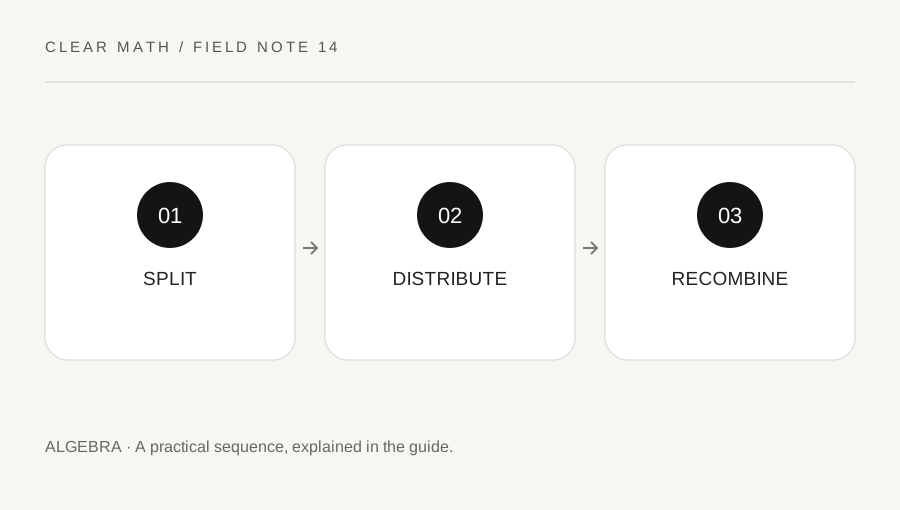
Original explanatory diagram. Numerical examples in this guide illustrate the reasoning; they are not a claim of hands-on testing.
See one rectangle as two smaller rectangles
Imagine a rectangle with height three and width five plus two. Its total area is 3 × (5 + 2) = 21 square units. Split the width into a five-unit section and a two-unit section. The smaller areas are 3 × 5 = 15 and 3 × 2 = 6; their sum is twenty-one.
This illustrates 3(5 + 2) = 3×5 + 3×2. The outside factor multiplies every term inside because the same height applies to both rectangles. Multiplying only the first term would omit an entire part of the area.
The picture uses positive lengths, while the algebraic property applies more broadly to signed numbers and expressions. Use the rectangle to understand the structure, then retain the algebraic relationship when negative terms no longer have a literal physical-length interpretation. Label the regions so the model explains each product rather than merely decorating the calculation.
Expand one term at a time
For 4(x + 3), multiply four by x and four by three, giving 4x + 12. For 5(2x − 1), the products are 10x and −5, so the result is 10x − 5. Draw an arrow to each inside term if that helps you remember both products.
Check by substituting a simple value. If x = 2, 4(x + 3) gives twenty, and 4x + 12 also gives twenty. One matching substitution does not prove an identity for every x, but it can expose a mistake quickly. The distributive property supplies the general reason.
Do not combine unlike terms after expanding. The expression 4x + 12 cannot become 16x, because twelve is a constant rather than twelve copies of x. Keep coefficients attached to their variable terms, and retain any untouched terms when copying the next line.
Handle negatives and reverse the process
For −3(x − 4), the first product is −3x and the second is positive twelve, giving −3x + 12. Multiplying a negative factor by negative four produces a positive term. A leading minus alone means multiplication by negative one: −(x + 5) = −x − 5.
Factoring reverses distribution. In 6x + 18, both terms share six, so write 6(x + 3). Expand it again to verify that both original terms return. The outside factor must divide every term in the intended expression, not just the term nearest to it.
For 8x − 12, the greatest common integer factor is four, giving 4(2x − 3). Factoring out two is also valid but less complete over integers. Avoid removing a factor from one term while leaving the other term unchanged inside the group.
Use the structure in arithmetic and equations
Distribution simplifies arithmetic: 7×19 = 7(20−1) = 140−7 = 133. It also appears in 2(x + 4) = 18. Expanding gives 2x + 8 = 18, then x = 5. Alternatively, divide both sides by two first to get x + 4 = 9. Both routes preserve equality.
Practice expanding 3(2x + 5) and −2(y − 6), then factoring 15a + 20. The results are 6x + 15, −2y + 12, and 5(3a + 4). Check each by reversing the operation and explain the positive constant in the negative example.
Write the general pattern a(b + c) = ab + ac. Read it as a relationship between equivalent expressions, not a demand to expand every group immediately. Sometimes a factored form shows the shared structure more clearly and needs fewer calculations. Choosing the useful form is part of understanding the property.
For a final sign check, substitute y = 1 into −2(y − 6). The original gives positive ten, and the expansion −2y + 12 also gives ten. The incorrect form −2y − 12 would give negative fourteen and is immediately exposed.
A practical checklist
Tick items for your own use. This checklist is saved only in this browser.
Questions that come up
Must I expand before solving an equation?
No. Sometimes undoing a nonzero outside factor first is simpler. Choose valid steps that preserve equality and keep the structure clear.
Does a minus before parentheses affect every term?
Yes. It represents multiplication by negative one, so every term changes sign when the group is expanded.
Can one numerical check prove an identity?
Not generally. A substitution can expose an error, but a valid algebraic property supplies the reason the expressions agree for all allowed values.
References & scope
Background references checked on 18 October 2026. The examples and practice exercises are original editorial explanations, not copied procedures or professional advice.