Ratios: Share a Total and Scale a Relationship
A ratio compares quantities in a stated order. Sharing a total and scaling a known pair are related tasks, but they start with different information. Label the parts before calculating.
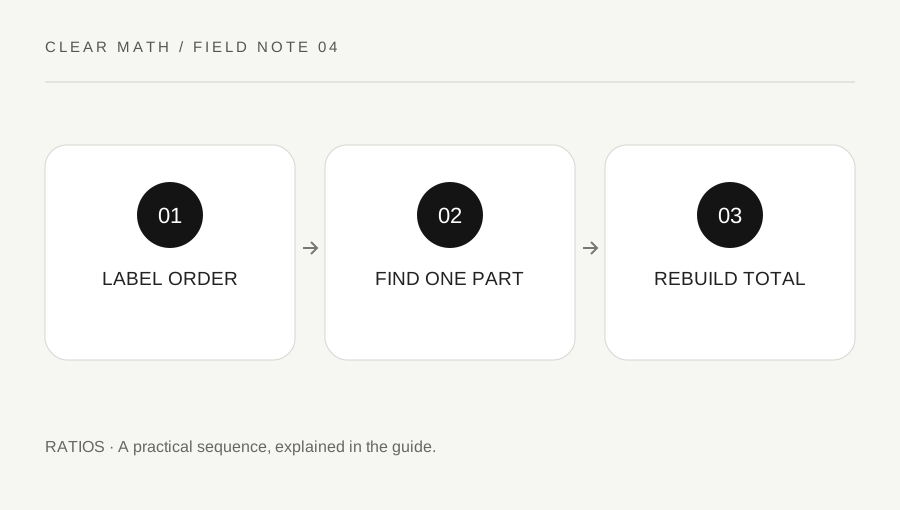
Original explanatory diagram. Numerical examples in this guide illustrate the reasoning; they are not a claim of hands-on testing.
Read the order and the units
A ratio of red counters to blue counters of 2:3 means two red parts for every three blue parts. It does not mean two red counters out of three counters altogether. The complete group has five equal-sized parts. Reversing the color order reverses the ratio, so include words beside both numbers.
Make units consistent before comparing measurements. Two meters to fifty centimeters becomes two hundred centimeters to fifty centimeters, or 4:1. Writing 2:50 without converting would compare unlike units. Ratios can describe unlike quantities too, such as distance to time, but then the units remain essential and the relationship is a rate. Do not discard them simply to make the notation shorter.
Share a total using equal parts
Share thirty-five counters in the ratio red:blue = 2:3. Add the ratio parts: 2 + 3 = 5. Divide the total by five to find seven counters per part. The red group gets two parts, or fourteen counters; the blue group gets three parts, or twenty-one. Confirm that fourteen plus twenty-one returns thirty-five.
Now check the relationship: 14:21 simplifies to 2:3 by dividing both values by seven. Both the total and the ratio must work. Giving fourteen red and nineteen blue counters would preserve neither check. If a fixed total cannot be divided into whole objects in the requested ratio, explain that limitation rather than rounding both groups independently and silently changing the relationship.
Scale a known pair without inventing a total
Suppose a display uses four green tiles for every seven white tiles. If it contains twenty green tiles, the scale factor from four to twenty is five. Multiply seven by five to obtain thirty-five white tiles. The total is fifty-five, but that total was a result rather than the starting input.
A common mistake is to divide twenty by eleven because eleven is the sum of the ratio parts. That would be correct only if twenty described the total number of tiles. Underline what the given number represents before using it. A two-column table labeled green and white can make this distinction clearer than an unlabelled string of multiplication signs.
Distinguish additive and proportional patterns
In the ratio 2:5, adding three to both numbers gives 5:8, which is not equivalent. Multiplying both numbers by three gives 6:15, which is equivalent. The difference between the original numbers is not the defining property; the multiplicative relationship is. You can test equality by comparing fractions 2/5 and 6/15.
For a drawing scale of 1:50, one centimeter on the drawing represents fifty centimeters in the object, assuming the same units. A line of 3.6 centimeters therefore represents 180 centimeters, or 1.8 meters. Convert units at a deliberate step. A mathematical scale exercise is not a substitute for an accurately surveyed plan or a construction specification.
Build a three-question check
Try sharing forty-eight beads in the ratio 5:3, extending a 3:7 pair when the first quantity is fifteen, and simplifying eighty centimeters to two meters. The answers are thirty and eighteen beads; fifteen and thirty-five; and 2:5 after converting two meters to two hundred centimeters.
For each answer, write what one part or the scale factor means. Then verify the total where a total is supplied, and verify the ratio in every case. If you cannot explain which input is a total and which is one side of a pair, stop before calculating. This reading step prevents a larger class of errors than memorizing a separate formula for every style of ratio question.
A practical checklist
Tick items for your own use. This checklist is saved only in this browser.
Questions that come up
Can a ratio have three components?
Yes. For 2:3:5, the total is ten equal parts. Divide a supplied total by ten, then allocate two, three and five of those parts.
Does 2:3 mean two thirds of the total?
No. The first quantity is two out of five total parts, or 2/5, when the two components make up the whole.
What if the quantities do not scale proportionally?
A fixed ratio model is then unsuitable. Check for an added fixed amount, a changing rate or missing information rather than forcing the ratio method.
References & scope
Background references checked on 18 October 2026. The examples and practice exercises are original editorial explanations, not copied procedures or professional advice.