Solve a One-Variable Equation and Check the Result
An equation states that two expressions have the same value. Solve it by preserving that equality, then substitute your answer into the original statement to see whether it works.
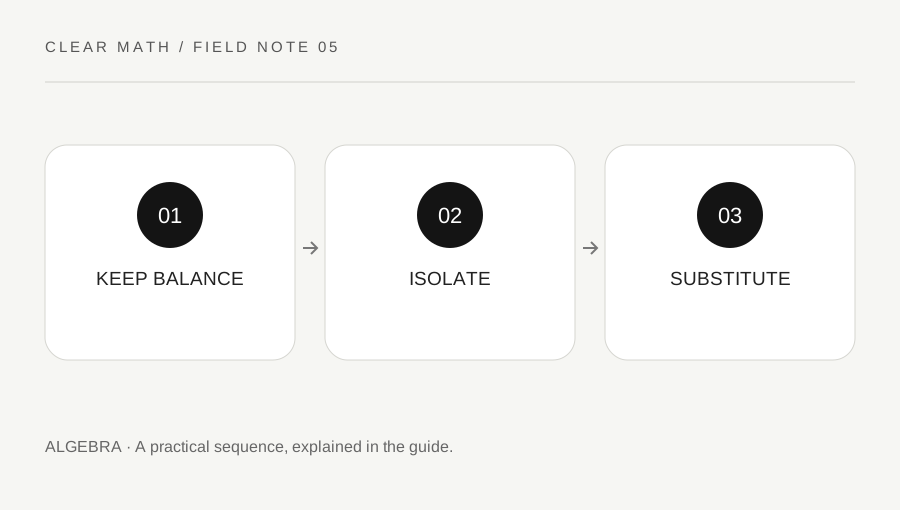
Original explanatory diagram. Numerical examples in this guide illustrate the reasoning; they are not a claim of hands-on testing.
Read the equals sign as a relationship
In 3x + 4 = 19, the equals sign says that the left expression and the right number have the same value for the solution. It is not an instruction to write whatever calculation comes next. The notation 3x means three times x, and 3x + 4 means multiply first, then add four.
A balance sketch can help: place three identical unknown blocks and four unit blocks on one side, with nineteen units on the other. Removing the same number of units from both sides preserves balance. The drawing is a model for the operation; you do not need to draw nineteen careful squares every time once the idea is clear. Keep the unknown blocks identical within the model: using different-sized blocks for the same variable would represent a different relationship.
Undo operations in a sensible order
To solve 3x + 4 = 19, subtract four from both sides, producing 3x = 15. Then divide both sides by three to obtain x = 5. Write both operations rather than saying a term “moves across” the equals sign and changes sign by itself. That shortcut can hide why the transformation is valid.
For (x − 2)/4 = 3, multiply both sides by four, giving x − 2 = 12. Add two to both sides to obtain x = 14. Think about the expression's structure: the entire numerator is divided by four. The same written symbols without parentheses could describe a different expression, so preserve grouping when copying a problem.
Expand and collect with care
Consider 2(x + 3) = x + 11. Distribute the two across both terms inside the parentheses: 2x + 6 = x + 11. Subtract x from both sides to get x + 6 = 11, then subtract six to get x = 5. Substitution gives 2(5 + 3) = 16 and 5 + 11 = 16.
For a negative multiplier, retain the signs: −2(x − 4) expands to −2x + 8, not −2x − 8. Circle each term being multiplied if needed. Only combine like terms: 2x + 3x = 5x, but 2x + 3 cannot become 5x because the constant three is not three copies of x.
Recognize special outcomes
Some equations do not have exactly one solution. Starting with 2x + 1 = 2x + 5 and subtracting 2x from both sides gives 1 = 5. That false statement means there is no solution. Starting with 2(x + 1) = 2x + 2 leads to 2x + 2 = 2x + 2, true for every real x, so there are infinitely many solutions in that domain.
Avoid dividing by a variable expression without considering when it equals zero. The beginner examples here use division by known nonzero constants. If a later problem introduces fractions containing x in a denominator, record the excluded values before transforming it. An algebraic manipulation must preserve both equality and the conditions under which the expressions are defined.
Check in the original equation
Try 5x − 7 = 18, 3(x − 1) = 12 and x/2 + 4 = 10. The solutions are five, five and twelve. For the last example, substitution gives 12/2 + 4 = 6 + 4 = 10. Check the original line rather than a later line that may already contain your arithmetic error.
Keep a small correction log with the equation, the first incorrect line and a short explanation. “Forgot to distribute to the second term” is more useful than “bad at algebra.” On your next practice attempt, choose one equation requiring that same operation. Build confidence by identifying a repeatable reasoning step, then increase complexity only when you can explain the simpler version clearly.
A practical checklist
Tick items for your own use. This checklist is saved only in this browser.
Questions that come up
Can I perform a different valid first step?
Yes. Several sequences can preserve equality and reach the same solution. Choose steps you can explain and verify rather than copying an unexplained order.
Is x always a whole number?
No. Solutions may be fractions, decimals, negative values or other allowed numbers. The equation and its stated domain determine what is possible.
Why is substitution necessary?
It catches transcription, sign and arithmetic errors. A candidate solution should make the original left and right sides equal.
References & scope
Background references checked on 18 October 2026. The examples and practice exercises are original editorial explanations, not copied procedures or professional advice.