Compare Fractions Using Benchmarks and a Number Line
A larger denominator does not automatically mean a larger fraction. Compare equal units, use useful benchmarks and remember that negative numbers reverse some familiar intuitions about size.
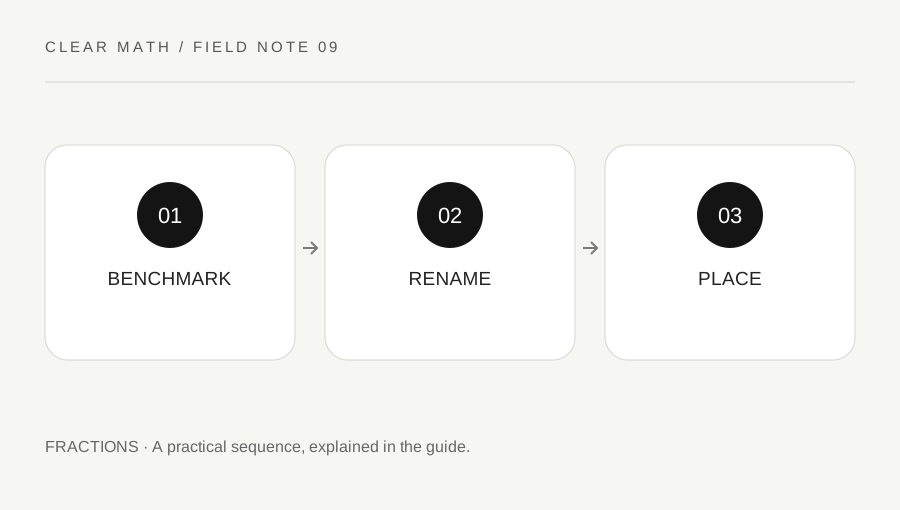
Original explanatory diagram. Numerical examples in this guide illustrate the reasoning; they are not a claim of hands-on testing.
Locate each fraction relative to familiar points
Begin with zero, one half and one. A positive fraction with numerator smaller than denominator lies below one. If its numerator is exactly half its denominator, it equals one half. For 5/8, compare five with half of eight, which is four: five eighths is above one half. Three sevenths is below one half because three is less than three and a half.
Those two benchmark checks already establish 5/8 > 3/7. You do not need a common denominator for every comparison. State the bridge explicitly: one fraction is above one half, the other below it. A rough sketch can show the order, but a line drawn by eye is not a proof of a close comparison unless its marked positions are constructed accurately.
Keep the whole consistent if using area models. A larger shaded drawing may represent a smaller fraction of a larger whole.
Use matching units when benchmarks do not settle it
Compare 7/12 and 5/8. Both exceed one half, so that benchmark alone is insufficient. Rewrite using denominator twenty-four: 7/12 = 14/24 and 5/8 = 15/24. Fifteen equal pieces exceed fourteen of the same pieces, so 5/8 is larger by 1/24.
With equal denominators, compare numerators. With equal positive numerators, a larger denominator means smaller pieces, so 3/10 < 3/7. That second statement assumes the same positive numerator and the same unit whole. It is not a general rule for fractions with different numerators.
Cross products provide another comparison for fractions whose denominators have been made positive. Compare 7 × 8 = 56 with 5 × 12 = 60. The same ordering follows, but explaining the common-denominator meaning helps prevent memorized cross multiplication from becoming a directionless trick.
Place negatives on the correct side
On a number line, values increase to the right. Negative one quarter lies closer to zero than negative three quarters, so −1/4 > −3/4. A greater magnitude does not mean a greater signed number. Say “three quarters away from zero on the negative side” if the notation feels confusing.
To compare −5/6 and −7/9, use eighteenth-sized units: −15/18 and −14/18. Negative fourteen eighteenth is to the right of negative fifteen eighteenth, so −7/9 is larger. If you compare the positive magnitudes first, you must reverse the ordering when applying a negative sign to both.
A negative denominator should be normalized before using familiar rules. The value 2/−5 equals −2/5, not a positive fraction with unusually small pieces. Move the sign to the numerator and keep the denominator positive for a clear comparison.
Order a set and check each neighboring pair
Order −2/3, 3/5, −1/4 and 7/6 from least to greatest. The negative values come first, with −2/3 below −1/4. Of the positive values, 3/5 is below one and 7/6 is above one. The final order is −2/3, −1/4, 3/5, 7/6.
Now compare a closer pair, 4/7 and 7/12. Common denominator eighty-four gives 48/84 and 49/84, so 4/7 is smaller. Their closeness shows why an imprecise picture can be misleading. Use the line to understand the order and exact arithmetic to settle small differences.
For practice, choose a method before calculating: compare 2/9 and 2/5, 9/10 and 11/12, and −3/8 and −1/2. The answers are 2/9 < 2/5, 9/10 < 11/12, and −3/8 > −1/2. Explain which benchmark or renaming step made each decision reliable.
A practical checklist
Tick items for your own use. This checklist is saved only in this browser.
Questions that come up
Does a bigger denominator always make a smaller fraction?
Only under appropriate conditions, such as the same positive numerator and the same unit whole. Different numerators require a complete comparison.
Can I compare rounded decimals?
They can provide an estimate, but rounding may hide a small difference. Keep exact fractions when a precise order is required.
What does the greater-than sign point toward?
Its narrow end points toward the smaller value. Read the entire statement aloud to check that the written direction matches your conclusion.
References & scope
Background references checked on 18 October 2026. The examples and practice exercises are original editorial explanations, not copied procedures or professional advice.