Simple Probability: Define the Outcomes Before Counting
The favorable-outcomes fraction requires equally likely outcomes. Define the experiment, list its possible results and check that assumption before converting counts into a probability.
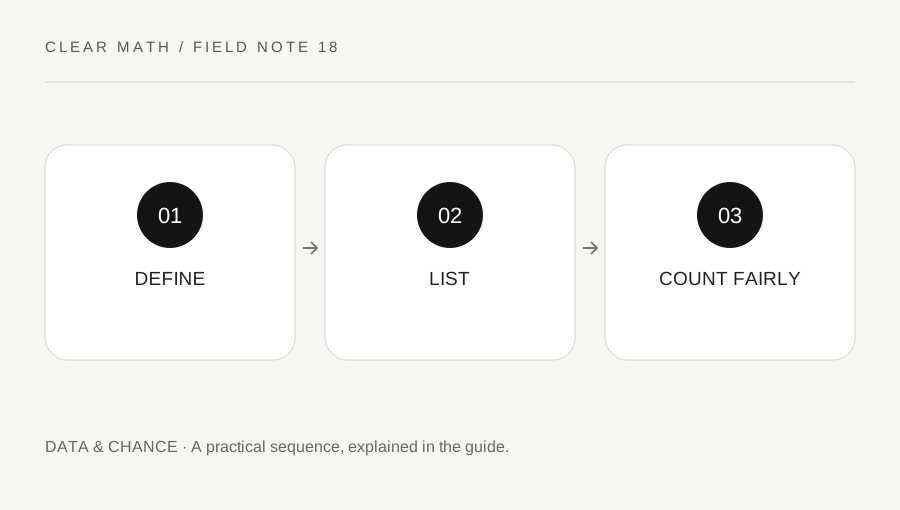
Original explanatory diagram. Numerical examples in this guide illustrate the reasoning; they are not a claim of hands-on testing.
Describe one trial and one event
For one roll of a fair six-sided die, possible face values are one through six. Fairness means each has probability one sixth. Even results are two, four and six: three favorable faces out of six equally likely faces, giving 3/6 = 1/2.
Fairness is an assumption, not something established by six faces alone. A weighted die can have unequal chances. Likewise, unequal spinner sectors do not become equally likely just because each has one label. Check the model before counting categories.
Separate the experiment from the event. “Roll once” is the experiment; “the result is even” is the event. This prevents counting outcomes from a different task, such as adding two rolls when one was specified. Write the complete outcome set even when the event sounds simple, because the denominator depends on that set and its likelihood structure.
List elementary outcomes completely
For two ordered flips of a fair coin, the outcomes are HH, HT, TH and TT. Under the usual independence assumption, they are equally likely. Exactly one head occurs in HT and TH, so the probability is 2/4 = 1/2.
“Zero heads,” “one head” and “two heads” are not three equally likely elementary outcomes. The middle category contains two ordered sequences and each outer category one. Assigning one third to every category ignores that difference.
Use a small table or tree for multi-stage tasks. Include every branch once and state whether order matters to the event. Even when an event ignores order, an ordered list may be the easiest way to count equally likely elementary outcomes. After counting, group the sequences satisfying the requested event rather than replacing the original sample space prematurely.
Check whether items are replaced
A bag contains three red and two blue counters. On one random draw, red has probability 3/5 if every counter is equally likely. After a red counter is drawn without replacement, two red and two blue remain, so the next red probability is 2/4.
If the counter is replaced and the bag appropriately mixed, the original composition returns and the next red probability stays 3/5. The procedure changes the model. Do not automatically reuse the initial denominator after the contents have changed.
For two reds without replacement, multiply 3/5 by 2/4 to obtain 3/10. This uses the staged conditional probabilities, not an assumption that all draws are independent. State the first observed or required result before calculating the next-stage chance, because drawing a blue counter first would leave a different composition.
Interpret the result without promising a pattern
A probability of one half does not guarantee five successes in the next ten trials. Small samples vary. Record the observed number and total trials separately, then compare their fraction with the model while keeping sample size visible.
Practice a die result greater than four, at least one head in two independent fair flips, and a blue draw from the original bag. The answers are 1/3, 3/4 and 2/5. For “at least one,” use the complement: only TT has no heads, so subtract one quarter from one.
Check that the final value lies between zero and one and that the counted outcomes belong to the defined experiment. A plausible fraction is insufficient if the outcomes were incomplete or unequal in likelihood. Finish by writing the assumptions alongside the answer, so another reader can see what would need to change for a different die, bag or drawing procedure.
A practical checklist
Tick items for your own use. This checklist is saved only in this browser.
Questions that come up
Does one-half probability require alternating results?
No. Independent trials can produce runs. A model probability does not force a particular pattern in each short sequence.
Can a probability exceed one?
No in the standard model. A value above one signals a counting, arithmetic or interpretation error.
Why are there two ways to get one head?
HT and TH are distinct ordered sequences, and both satisfy exactly one head. Both must be included in the event count.
References & scope
Background references checked on 18 October 2026. The examples and practice exercises are original editorial explanations, not copied procedures or professional advice.