Mixed Numbers and Improper Fractions: Keep the Whole Visible
A mixed number combines a whole-number part and a proper fraction. Convert by counting equal fractional units, and pay particular attention to grouping when negative signs are involved.
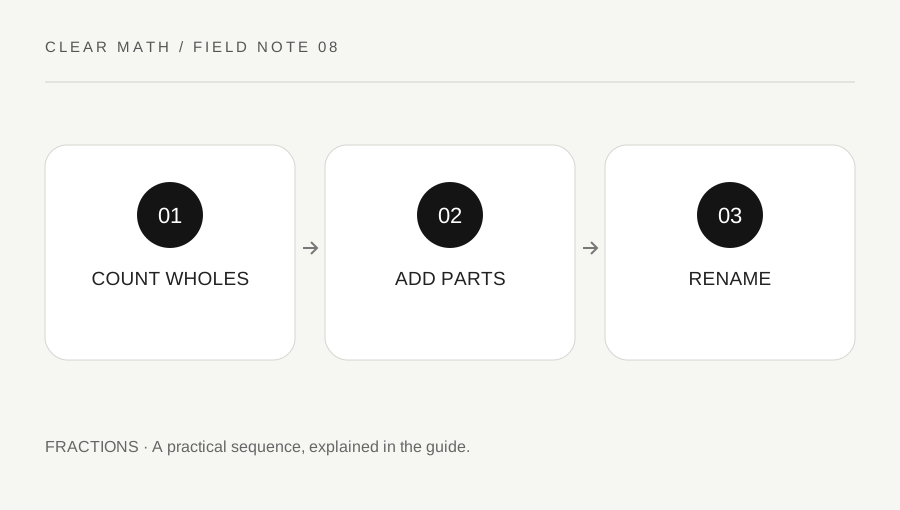
Original explanatory diagram. Numerical examples in this guide illustrate the reasoning; they are not a claim of hands-on testing.
Interpret the mixed notation as addition
The mixed number 2 3/5 means two plus three fifths. Imagine two complete strips and three fifths of another strip, all based on equal-sized wholes. It does not mean two multiplied by three fifths. That distinction matters when entering a value into a calculator or writing an algebraic expression.
In typed text, use an explicit plus sign or parentheses when the notation might be unclear: 2 + 3/5. The fraction calculator on this site accepts integer numerators and denominators, so convert a mixed number before entering it. Writing “2.3” is not a substitute for 2 3/5; the decimal 2.3 equals two and three tenths.
Check whether the fractional part is proper. A notation such as 2 8/5 can describe a sum, but it is not a conventional normalized mixed number because the fraction contains another whole.
Convert to an improper fraction
For 2 3/5, each whole contains five fifths. Two wholes therefore contain ten fifths. Add the remaining three fifths to get thirteen fifths: 2 3/5 = 13/5. The compact calculation is 2 × 5 + 3 = 13 for the numerator, with denominator five retained.
Try 4 1/6. Four wholes are twenty-four sixths; adding one gives 25/6. The denominator continues to describe the unit size. A frequent error is to add the whole number directly to the numerator, producing 5/6, which loses nearly all the quantity represented.
Estimate before calculating. A positive mixed number beginning with four must lie between four and five when its fractional part is proper and positive. The fraction 25/6 is about 4.17, which fits. Five sixths is below one and clearly fails that check.
Convert back by division with a remainder
To express 17/4 as a mixed number, divide seventeen by four. Four fits four whole times with one remaining, so the result is 4 1/4. The remainder becomes the numerator of the fractional part and the original denominator stays four. Check by rebuilding: 4 × 4 + 1 = 17.
For 23/6, three wholes use eighteen sixths and leave five, giving 3 5/6. For 18/6 there is no remainder, so the result is the integer three. Do not attach an unnecessary fractional part with denominator zero; zero sixths is valid, but a zero denominator is never valid.
If the remainder fraction can simplify, reduce it. For 22/8, division gives 2 6/8, which becomes 2 3/4. You may also simplify 22/8 to 11/4 first and then divide.
Handle negatives and choose a useful form
The conventional negative mixed number −2 1/3 means the negative of the entire quantity 2 + 1/3, so it equals −7/3. It does not mean −2 + 1/3, which equals −5/3. Use parentheses, −(2 + 1/3), when teaching or typing the distinction.
For multiplication or division, improper fractions often make the calculation clearer because each quantity is represented by one numerator and one denominator. For describing a length on a number line, a mixed form may make the whole-number position easier to see. Neither form has a different numerical value.
Practice converting 3 2/7, 29/5 and −1 3/4. The answers are 23/7, 5 4/5 and −7/4. Finish with a location check: the first lies between three and four, the second between five and six, and the third between negative two and negative one. That check connects the notation to a quantity rather than a mechanical conversion rule.
A practical checklist
Tick items for your own use. This checklist is saved only in this browser.
Questions that come up
Is an improper fraction an incorrect fraction?
No. “Improper” means its numerator magnitude is at least as large as its denominator magnitude in the usual positive-denominator form. It is a valid representation when the denominator is nonzero.
Should I always convert the final answer to a mixed number?
Follow the task instructions. A reduced improper fraction is often the clearest exact answer for calculations; a mixed form can help interpret its size.
Can I type a mixed number into the tool?
Not directly. Convert it to an integer numerator and nonzero denominator first, then use the two input fields.
References & scope
Background references checked on 18 October 2026. The examples and practice exercises are original editorial explanations, not copied procedures or professional advice.