Decimal Place Value and Rounding: Keep the Position Clear
A decimal digit gets its value from its position. Read the places first, then use the next place to decide a rounding step. Zeros can preserve meaning even when they do not change the numerical value.
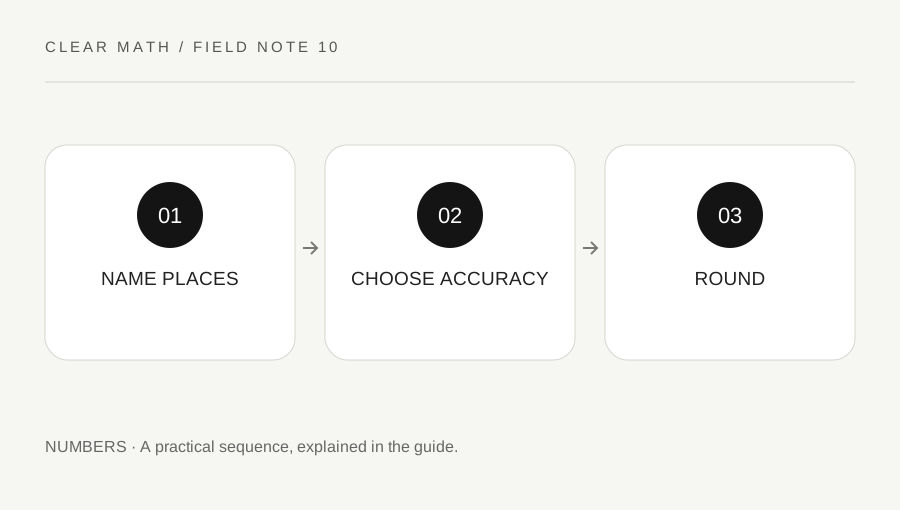
Original explanatory diagram. Numerical examples in this guide illustrate the reasoning; they are not a claim of hands-on testing.
Read the digits as units of different sizes
In 4.372, the four counts ones, the three counts tenths, the seven counts hundredths and the two counts thousandths. You can write the number as 4 + 3/10 + 7/100 + 2/1000. Each place to the right represents one tenth of the value of the previous place.
The decimal point is a position marker, not a separator between two unrelated whole numbers. Reading 4.372 as “four point three seven two” is clear, while “four and three hundred seventy-two” can conceal the fractional unit. Four and three hundred seventy-two thousandths is the complete place-value reading.
Use a small place-value table when comparing several numbers. Align decimal points so that tenths appear above tenths and hundredths above hundredths. Aligning final digits instead would compare different unit sizes and can produce a wrong order.
Understand useful zeros
The values 0.5, 0.50 and 0.500 are numerically equal because five tenths, fifty hundredths and five hundred thousandths represent the same amount. A trailing zero to the right of the decimal can make place alignment easier without changing the number. By contrast, the zero in 0.05 is essential: five hundredths is one tenth of five tenths.
Compare 0.48 and 0.5 by writing 0.48 and 0.50. Forty-eight hundredths is below fifty hundredths, so 0.48 is smaller even though its final digit is larger than five. Do not compare decimals as if the digits after the point were whole numbers.
In measured data, written zeros can communicate reported precision, which is a separate topic from numerical equality. A school arithmetic exercise may treat 2.0 and 2 as the same value while a measurement report uses their notation more deliberately.
Round at a stated place
To round 6.478 to the nearest hundredth, keep the hundredths position, seven, and inspect the next digit, eight. Under the usual school half-up convention for positive numbers, increase the hundredths digit to eight. The rounded result is 6.48. The original number lies closer to 6.48 than to 6.47.
For 6.472, the next digit is two, so the nearest hundredth is 6.47. State the target place before inspecting digits; otherwise you may apply a correct rule to the wrong position. If rounding 9.996 to the nearest hundredth, carrying produces 10.00, not 9.100.
Ties can follow different conventions in software and technical settings. When the next discarded portion is exactly halfway, use the convention requested by the task. This page's elementary positive-number examples use the familiar half-up rule rather than claiming that every application rounds ties identically.
Estimate and avoid repeated rounding
Suppose you need to add 3.186 and 2.277, then report to the nearest hundredth. Add the original values to get 5.463, then round once to 5.46. Rounding both inputs first gives 3.19 + 2.28 = 5.47, a different result. Keep sufficient intermediate detail unless the problem explicitly requests estimation at each stage.
Practice comparing 0.7 with 0.67, rounding 12.348 to hundredths, and rounding 4.995 to hundredths using the stated half-up convention. The answers are 0.7 > 0.67, 12.35 and 5.00. Explain why the last result retains two decimal places even though it equals the integer five numerically.
Finish by marking the target digit and the deciding digit in two different ways. That small annotation makes a rounding error easy to locate and helps distinguish a place-value misunderstanding from an ordinary carrying mistake.
A practical checklist
Tick items for your own use. This checklist is saved only in this browser.
Questions that come up
Are 0.40 and 0.4 equal?
Yes as numbers. The extra trailing zero does not change the value. In measurement contexts, notation can additionally indicate a stated reporting precision.
Why is 0.09 smaller than 0.1?
Write 0.1 as 0.10. Nine hundredths is less than ten hundredths. Comparing nine with one as whole numbers ignores place value.
Does this explain every software rounding method?
No. Software may use tie-to-even or other rules, and binary representation adds further considerations. Follow the convention specified for the calculation.
References & scope
Background references checked on 18 October 2026. The examples and practice exercises are original editorial explanations, not copied procedures or professional advice.